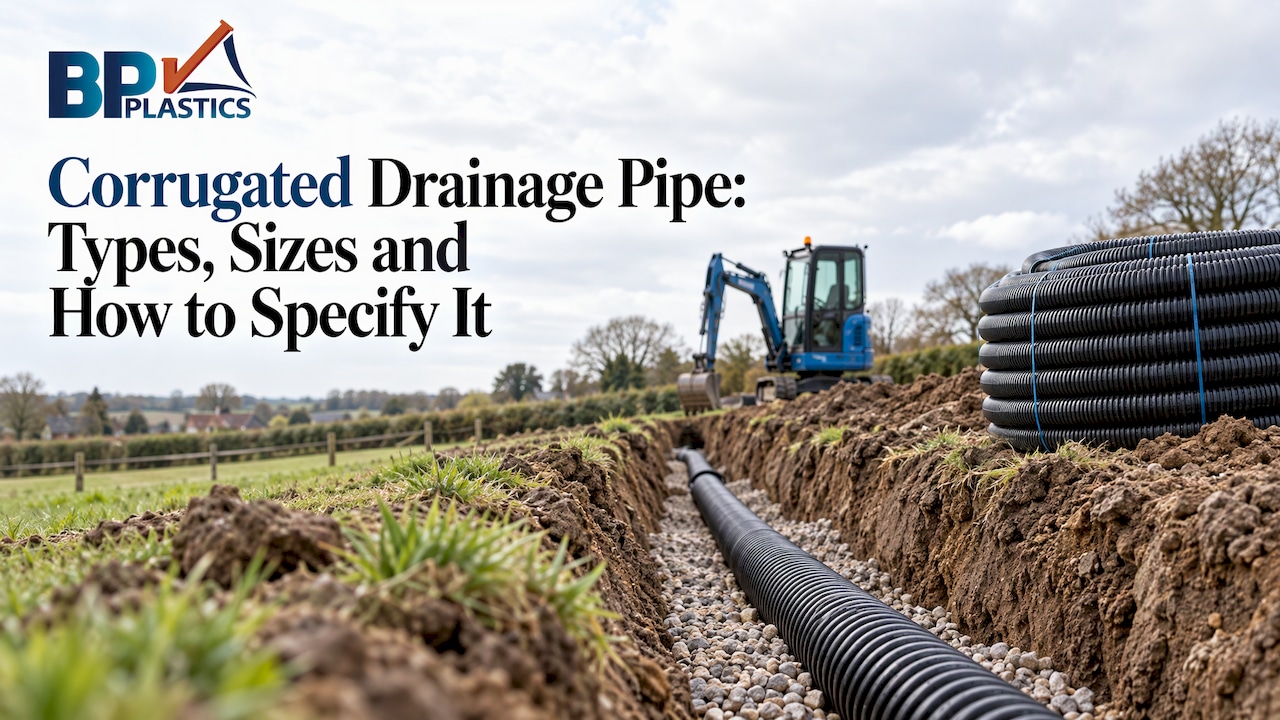
Corrugated drainage pipe is plastic pipe with a ribbed wall that makes it light, flexible and strong against soil load. In the UK it comes in two main forms: single-wall coiled land drain for field and garden drainage, and twin wall (smooth bore, ribbed outside) for below-ground gravity drainage. Choose by the job: perforated coil to collect groundwater, plain or twin wall pipe to carry water to an outfall. We supply both lines, along with the chambers, couplers and geotextiles that go with them.
TL;DR
- Perforated corrugated pipe collects groundwater (land drain). Unperforated or twin wall pipe carries water to a soakaway, ditch or sewer.
- Structured-wall plastic pipe to BS EN 13476 is listed in Approved Document H as an accepted flexible material for below-ground gravity drainage in England.
- Corrugation adds strength but also roughness, so size the pipe for the flow and lay it to a steady fall of 1:250 or steeper in practice.
- A firm, shaped bed, correct cover depth and proper couplers matter more to the finished drain than the pipe price.
- Buy pipe, couplers, chambers and wrap from one range so the sizes and connections match.
Table of Contents
- What corrugated drainage pipe is
- Single-wall, twin wall and smooth pipe: which to use
- Sizes: how to pick a diameter
- Standards and Building Regulations
- Installing corrugated underground drain pipe
- Using it well: conditions to plan for
- Materials compared: PE, PP and PVC-U
- What affects price
- Choosing fittings
- Where to buy it
- FAQ
- Sources
What corrugated drainage pipe is
A corrugated pipe has a ribbed wall rather than a smooth one. The ribs give stiffness without needing a thick wall, so the pipe resists squashing from soil and traffic while staying flexible enough to be laid from a coil or in long lengths. The FAO’s study of land drainage materials explains that the corrugated shape makes the pipe more flexible and more resistant to compression than a smooth pipe made from the same amount of raw material.
The same study notes that in the UK corrugated drains are mainly made of polyethylene (PE), with a minority in polypropylene (PP), whereas much of the rest of Europe uses PVC. That is why most coiled land drain you meet on UK sites is PE, and why twin wall ranges are usually PP or PVC-U.
There is also an international standard for the single-wall type: BS ISO 19469-3 covers single-wall corrugated piping in PE, PP and PVC-U for non-pressure underground drainage, including pipes and fittings for deep burial.
Single-wall, twin wall and smooth pipe: which to use
The label “corrugated” covers different constructions, and they do different jobs.
| Type | Wall | Typical job | Notes |
|---|---|---|---|
| Single-wall corrugated, perforated | Ribbed inside and out, with slots | Land drains, French drains, soakaway feeds, pitch and garden drainage | Sold in coils; slots let groundwater in |
| Single-wall corrugated, unperforated | Ribbed inside and out | Carrying water to a ditch or outfall, culverts | Flexible and light |
| Twin wall (dual-wall) | Ribbed outside, smooth liner inside | Surface water and below-ground gravity drainage | Smoother bore improves flow |
| Solid-wall PVC-U (BS EN 1401) | Smooth | Foul and surface water drains | Rigid lengths with sockets |
The PPI Drainage Handbook describes single-wall corrugated HDPE as suited to projects where flexibility, light weight and low cost matter, and dual-wall pipe with a smooth liner as the preferred choice for stormwater because of its light weight, strength and hydraulic performance. Both are the same idea at different levels of performance.
Perforated or unperforated?
The rule is simple. If the pipe’s job is to take water out of the ground, use perforated pipe, laid in a gravel surround or wrapped in geotextile so the slots do not silt up. If the job is to move water from A to B, such as from a gutter downpipe or chamber to a soakaway, use unperforated pipe, or the plain ended pipe used in a conventional underground system.
For land drainage, our 160mm x 50m coil of perforated land drain is the kind of product this describes: a long run from a single coil means fewer joints.
Sizes: how to pick a diameter
Size by the flow the drain must carry, not by what is easy to carry on site. Domestic garden and field drains are typically small bore, while surface water from roofs and hardstanding, and drains running to a sewer, are usually 110mm or 160mm at the smaller end and larger for developments. Twin wall pipe goes much bigger: the PPI handbook notes that dual-wall corrugated polypropylene is commercially available in 300 to 1500mm diameters, typically in 6m lengths, and used in culvert and storm sewer applications. For the largest flexible corrugated unperforated pipe in water-carrying roles such as culverts, Conservation Handbooks gives up to 310mm for the single-wall type.
Two practical points on choosing the diameter:
- Allow for the ribs. Corrugated pipe has a higher hydraulic roughness than smooth pipe. The same UK reference says you need about a 20% increase in diameter to carry the same flow as a smooth pipe. Twin wall’s smooth liner avoids much of that penalty.
- Never reduce downstream. A drain should stay the same size or get bigger as it runs towards the outfall. Stepping down is how blockages start.
A larger bore also gives you more rodding access later and some margin for silt, which suits a drain you expect to leave buried for decades.
Standards and Building Regulations
If the drain serves a building in England, Approved Document H (2015 edition) is the guidance to follow. Its Table 7 lists structure-walled plastic pipes to BS EN 13476 as an accepted flexible pipe material for below-ground gravity drainage, next to uPVC to BS EN 1401 and polypropylene to BS EN 1852. The application area code normally specified is UD (underground drainage). Scotland, Wales and Northern Ireland have their own building standards, so check the local version for a regulated job.
For a garden land drain that serves no building, regulations are lighter, but the same installation habits apply. For a deeper walk through pipes, fittings and the regulations, see our guide to plastic drainage systems in the UK.
Installing corrugated underground drain pipe
Flexible pipe takes its strength from the ground around it. Approved Document H notes that flexible pipes deform under load and need support to limit that deformation, so the trench is part of the product.
Bed and surround
Cut a firm, even trench base and shape it so the pipe sits on it along its whole length. The NAAC field drainage specification asks for a firm, smooth bed shaped to support the pipe and corrugated pipe laid straight, free from kinks or stretching. Lay perforated pipe slots down or as the manufacturer directs, and surround it with clean aggregate, or wrap it in geotextile where the soil is fine and silty.
Cover depth and bedding
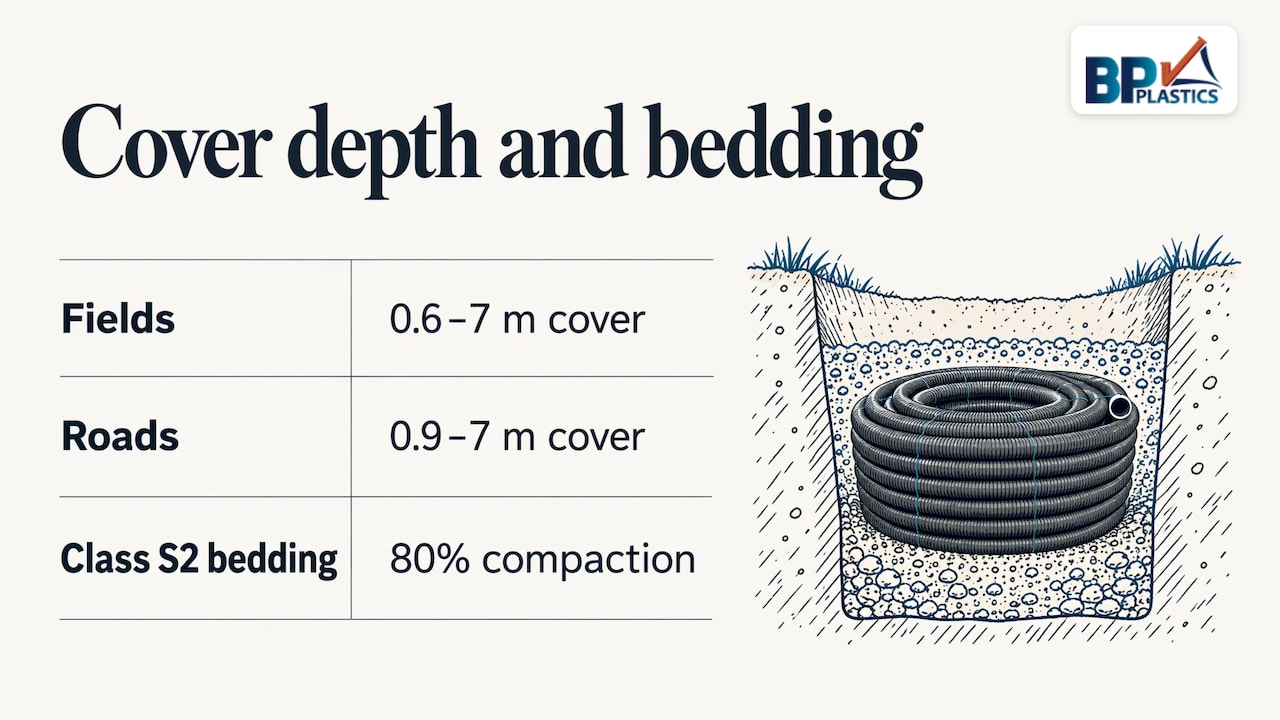
Approved Document H, Table 10, allows SN4 thermoplastic pipe of 100 to 300mm with cover from 0.6m to 7m in fields and from 0.9m to 7m under roads, using Class S2 bedding compacted to 80%. Under a driveway or any trafficked area, check the stiffness class (SN rating) printed on the pipe against the cover you can achieve, and ask the pipe supplier or your engineer where the table does not fit your case.
Gradient and changes of direction
Pipes are laid to even gradients, with any change of gradient combined with an access point, in straight lines where practicable, and bends only in or close to inspection chambers. Conservation Handbooks gives a useful practical figure: drains can work in theory on a fall as gentle as 1:660, but in practice the fall should be 1:250 or steeper to allow for local variations in the trench.
On a site where levels do not allow a continuous fall, a pumped system is the alternative to a gravity run, and the trade-offs are laid out in this explanation of gravity drain versus pump.
Joints and backfill
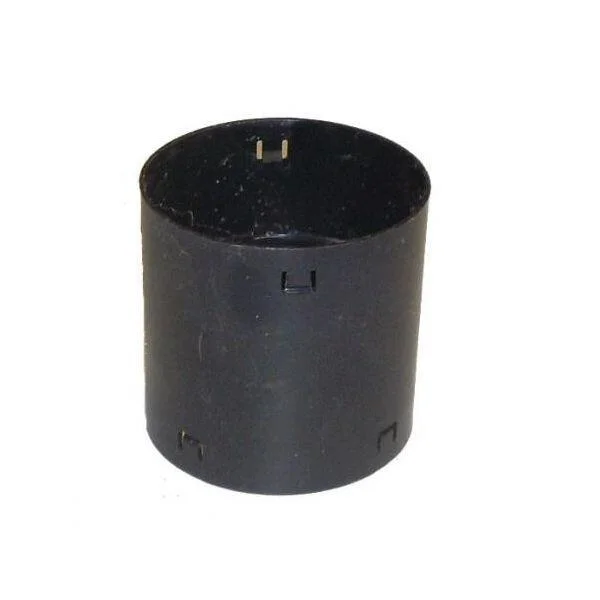
Use couplers matched to the pipe, so that the joint resists pulling apart as the ground settles. A matched part such as our 160mm coupler for land drainage keeps a coil run continuous. Put inspection chambers at changes of direction, junctions and gradient changes, then backfill in compacted layers rather than tipping the spoil in one go.
Using it well: conditions to plan for
Plastic corrugated pipe performs best when installed as designed. The FAO study lists points that decide good practice on site:
- Keep it covered. Sunlight degrades plastic over time, especially PVC, so coils should be stored shaded and the pipe buried soon after delivery.
- Handle with care in cold weather. Plastic gets more brittle at low temperatures, so uncoil and lay gently on frosty mornings.
- Protect it in heat. High temperatures raise the risk of deflection, so don’t leave coils in the sun or backfill when the pipe is hot.
- Avoid sudden heavy loads over shallow runs. Keep plant and vehicles off the line until the cover is in place, and use the stiffness class and depth Approved Document H gives for trafficked areas.
- Size for the roughness. The ribs reduce transport capacity for the same inner diameter, which is why the diameter step above matters.
Those are the points a site agent checks before a trench closes. Treat them as a short checklist and the pipe will do what its specification says.
Materials compared: PE, PP and PVC-U
Drainage pipe material types come down to three plastics in UK practice:
- Polyethylene (PE or HDPE): the standard for coiled corrugated land drain in the UK, flexible and light.
- Polypropylene (PP): used for twin wall pipe. The PPI handbook says PP has a higher flexural modulus than HDPE, so the finished pipe is stiffer.
- PVC-U: the rigid smooth-wall choice to BS EN 1401, and also made in structured-wall forms. See our pages on uPVC underground drainage pipe and underground drainage pipe in general.
The FAO study explains why plastic corrugated pipe replaced clay and concrete in land drainage: it is flexible, suits mechanised and trenchless installation, and its larger, evenly spread perforation area lets water in easily, which cuts installation cost significantly.
What affects price
Price depends on diameter, wall construction, stiffness class, length per coil or pipe, and whether you need perforation or a geotextile wrap. A useful point from Conservation Handbooks is that corrugated and smooth pipes with similar flow capacity cost about the same per metre, because a smooth pipe of the same diameter needs more plastic. So compare on capacity and stiffness class, not just the headline per-metre figure. Fittings, chambers and wrap add to a job, which is why buying the lot together tends to be cheaper than assembling them from several places.
Choosing fittings
Match these in order:
- Pipe type and diameter: a coupler or adaptor must be made for that pipe profile.
- Connection to rigid systems: where corrugated or twin wall meets solid-wall PVC-U, use an adaptor made for it, such as the socket adaptor from twin wall to EN 1401 PVC spigot pipe.
- Access and silt control:600mm catch pits for 110mm and 160mm drainage or 450mm and 600mm catchpits for twin wall stormwater give you somewhere to catch silt and rod the line.
- Geotextile: wrap perforated pipe or line the trench where fines could enter.
Where to buy it
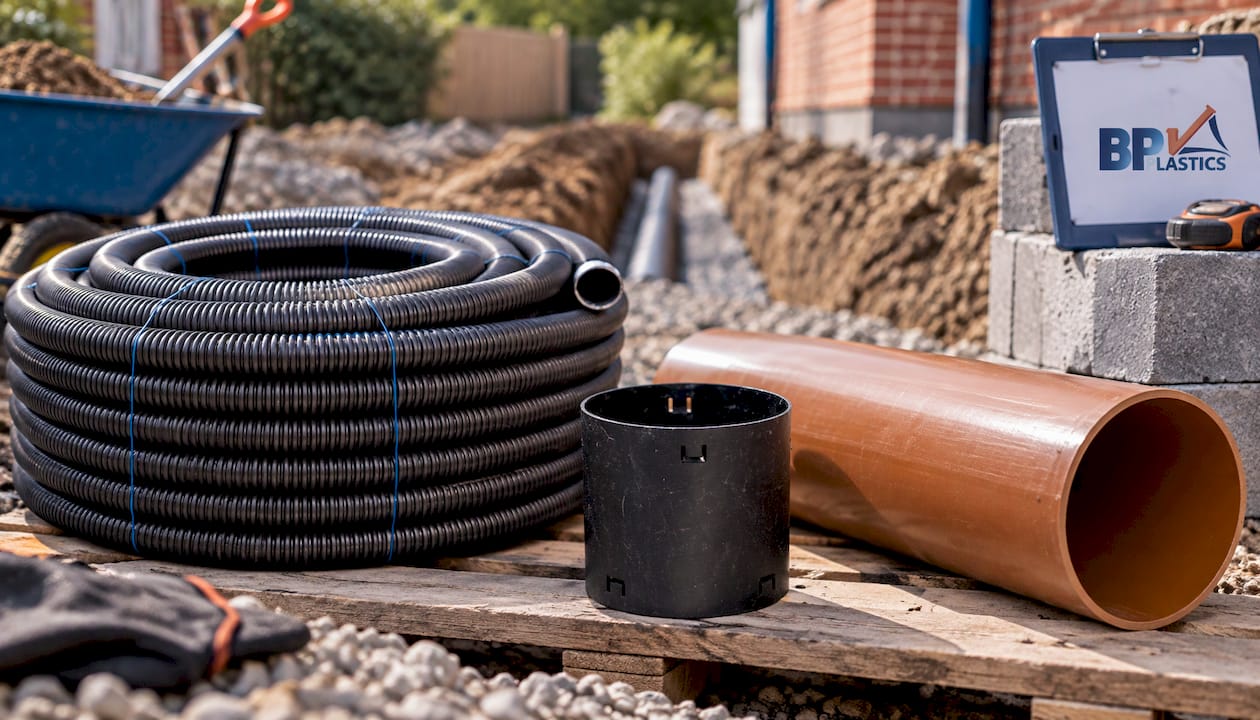
We supply underground drainage products for contractors, groundworkers, landscapers and homeowners: twin wall pipe and fittings, land drainage pipe and fittings, inspection chambers, geotextiles and more, with bulk buy deals for larger jobs. If you are pricing a run, start with the Plastic Drainage range and add the coupler, chamber and wrap to the same basket so the sizes line up.
If you are laying a longer run, the 250mm underground drainage pipe in 6m plain ended lengths covers the larger-bore carrier side, and the 110mm underground drainage starter kit bundles the parts for a smaller system.
FAQ
Can I use corrugated pipe for drainage?
Yes. Structure-walled plastic pipe to BS EN 13476 is listed in Approved Document H as an accepted flexible material for below-ground gravity drainage, and single-wall perforated pipe is the standard choice for land drains. Match the type to the job and follow the bedding and cover guidance.
Which pipe is best for a drainage line?
For collecting groundwater, perforated corrugated land drain in gravel or wrapped in geotextile. For carrying surface water or serving a building, twin wall or solid-wall PVC-U with matching fittings and chambers. Size it for the flow and keep a steady fall.
What fall does a corrugated drain need?
In theory a drain can work on as little as 1:660, but in practice aim for 1:250 or steeper to allow for small variations in the trench. Any change of gradient should coincide with an access point.
How deep should corrugated pipe be buried?
Approved Document H allows SN4 thermoplastic pipe of 100 to 300mm at 0.6m to 7m cover in fields and 0.9m to 7m under roads, with Class S2 bedding compacted to 80%. Check the stiffness class on the pipe against your cover.
Sources
- BS ISO 19469-3, BSI Knowledge
- Approved Document H, 2015 edition
- FAO, Materials for subsurface land drainage systems
- PPI Drainage Handbook, chapter 4
- Conservation Handbooks, Pipes
- Gravity drain versus pump