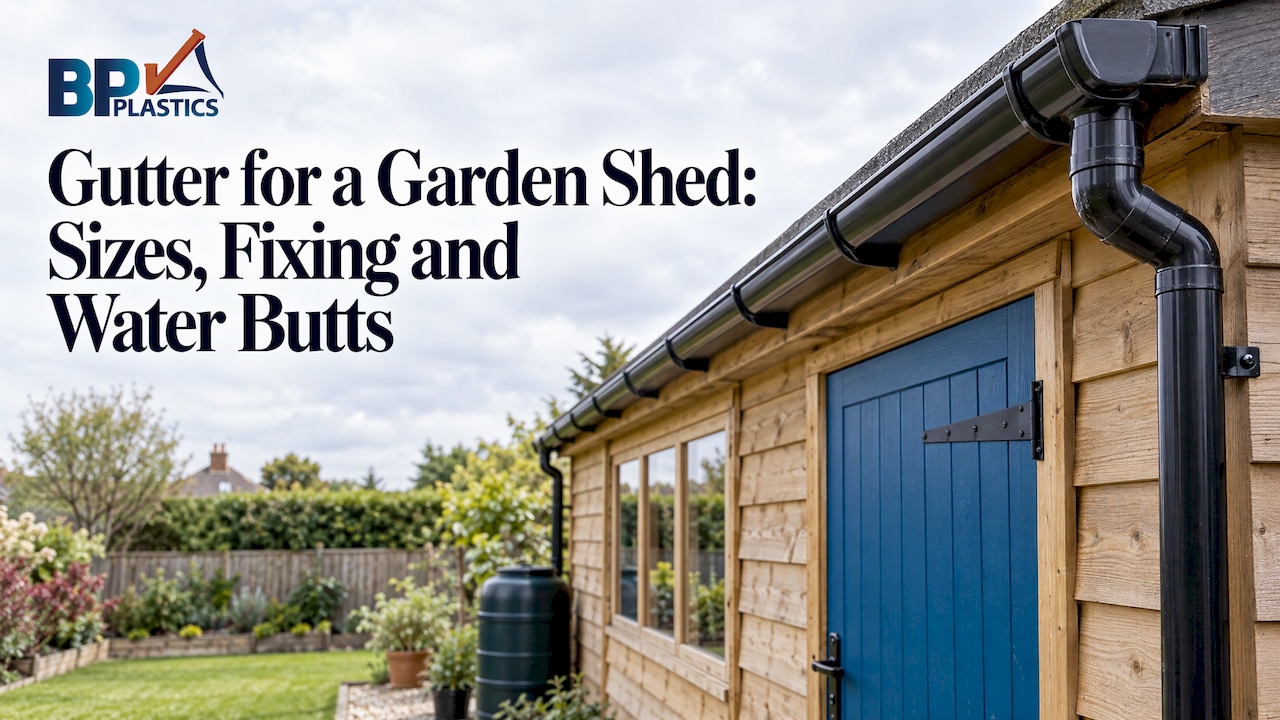
A garden shed needs a small, low-profile gutter and a narrow downpipe, fixed to a fascia board along the lower edge of the roof, with a fall of a few millimetres per metre towards the outlet. That setup carries the roof’s run-off away from the timber, and it can feed a water butt. This guide covers how to size the system, what to buy, how to fix it and where the water should go. It also covers when a shed, garage or workshop is big enough to need a full-size system. Our range at Plastic Drainage covers guttering, downpipes and fittings, so the same supplier can handle the bigger outbuilding jobs.
TL;DR
- Most garden sheds have a small roof, so a compact gutter with a narrow downpipe copes. Bigger outbuildings, garages and workshops need a full-size system.
- Fix the gutter to a fascia board around the roof edge where you can. It gives a stronger, more stable base than screwing brackets into the wall, according to Shedstore’s installation guide.
- Set a slight fall towards the outlet, and decide where the water goes (drain, water butt or sloping ground) before you buy anything.
- Work out your roof area first. One millimetre of rain on one square metre is one litre of water, so the sums are easy.
- Buy lengths, stop ends, outlets, brackets and downpipe clips as one list, with a few spare brackets.
Table of Contents
- Why a shed needs a gutter at all
- What size gutter and downpipe does a shed need?
- Choosing a gutter type for your roof
- Can you fit guttering to a Keter shed?
- How to fit a gutter to a garden shed
- Connecting the gutter to a water butt or a drain
- Maintenance: keeping a shed gutter working
- Shopping list for a typical shed
- Where Plastic Drainage fits in
- FAQ
- Sources
Why a shed needs a gutter at all
Most sheds are sold without any guttering. Rain runs off the roof edge in a sheet, lands at the base of the walls and splashes back up onto the cladding. Over a few winters that keeps the bottom boards and the floor frame permanently damp. It also leaves a muddy trench along the drip line, and it wastes water you could be collecting.
A gutter fixes all three. It gathers the water, delivers it to one point and lets you decide what happens next. For a contractor fitting out a garden room or a landscaper finishing a garden project, it is a small job that gets noticed by the client. For a homeowner, it is usually an afternoon’s work.
What size gutter and downpipe does a shed need?
The answer depends on the roof area and the rainfall it has to shed, not on the look of the building. A shed roof of a few square metres produces very little flow even in heavy rain, so a compact half-round gutter with a narrow round downpipe is the normal choice. A full-size domestic gutter would be oversized and visually clumsy against a low eaves line, and the brackets would need more fascia depth than many sheds have.
Use this quick check:
- Measure the roof, not the floor. Include the overhang. Take length times the horizontal depth of the slope.
- Multiply by the rain you want to plan for. Every millimetre of rainfall on one square metre gives one litre. A roof of 2.4 m by 1.8 m is 4.32 m², so a 10 mm downpour puts roughly 43 litres through the gutter.
- Compare that with the outbuilding. A shed roof under about 10 m² is the small-gutter territory. Once a roof is wider, runs to a garage or has a long single slope, move up to a full-size system with a larger downpipe.
The 10 m² line is a practical rule of thumb for choosing between a compact and a full-size system, not a regulation. Whichever size you choose, keep the whole system from one range. Gutter profiles, brackets, stop ends and outlets from different ranges rarely seal properly, and mixing them is the commonest reason a new shed gutter drips at the joints.
When to step up to a full-size system
Many garden buildings are larger than the classic 6 by 4 shed: workshops, garden offices, log stores and double garages. For these, a standard domestic system is the sensible option. Our range includes half-round and ogee-style guttering, high-capacity fascia brackets and a wide choice of angles and adaptors, such as the Squarestyle to half round adaptor for joining one profile to another. If the outbuilding sits beside the house and you want the gutter to match, a full-size system lets you carry the same profile across.
Groundworkers and builders doing several outbuildings will also find that ordering gutter, downpipe, clips and fittings in one go is cheaper than topping up from a hardware store, and it keeps every run in the same colour and profile.
Choosing a gutter type for your roof
Shed roofs come in three common shapes, and the shape decides the layout.
| Roof type | Where the gutter goes | Typical layout |
|---|---|---|
| Single slope (apex-free, lean-to style) | Along the low edge only | One run, outlet at one end or in the middle |
| Apex (pitched) | Along both eaves, or one only if the other side drains into a border | Two runs, often joined to one downpipe |
| Pent with deep overhang | Along the low edge, fixed to the fascia | One run, stop end at the high end |
Plastic half-round gutter is the usual material for sheds because it is light, will not rust and is simple to cut with a fine-toothed saw. Square and ogee profiles suit larger or more formal buildings. For a garden shed, pick the profile that matches the fascia depth and the look you want, then check that every fitting you need exists in that range: stop ends, running outlets, angles if the roof turns a corner, and a downpipe adaptor.
Fascia boards, and why they matter
Gutter brackets need something solid to bite into. Shedstore’s UK guidance says a fascia board fitted around the roof edge gives a strong, stable framework and is generally preferred to fixing straight to the wall, which depends on the wall’s structural integrity (Shedstore installation guide). Thin shed roof boards and felt overhangs flex under the weight of a full gutter, particularly when it is full of water or leaves.
If your shed has no fascia, you can fit a timber batten along the eaves first. Fix it into the roof frame, not just the cladding, and treat the cut ends. Plastic and uPVC fascia and soffit boards are among the things we supply, so they can be ordered alongside the gutter if you are building a new outbuilding or refreshing an old one.
Can you fit guttering to a Keter shed?
Resin and plastic sheds such as Keter models usually have a moulded roof with no timber fascia, so there is nothing obvious to screw brackets into. In practice the choices are to use manufacturer-approved fixings if the maker offers a gutter option, or to build a small timber support the roof edge sits against. Check the shed’s instructions and the manufacturer’s guidance first, because drilling into moulded panels can affect the structure and the guarantee. Where you add a support, keep the fall and the downpipe position the same as for any other shed.
How to fit a gutter to a garden shed
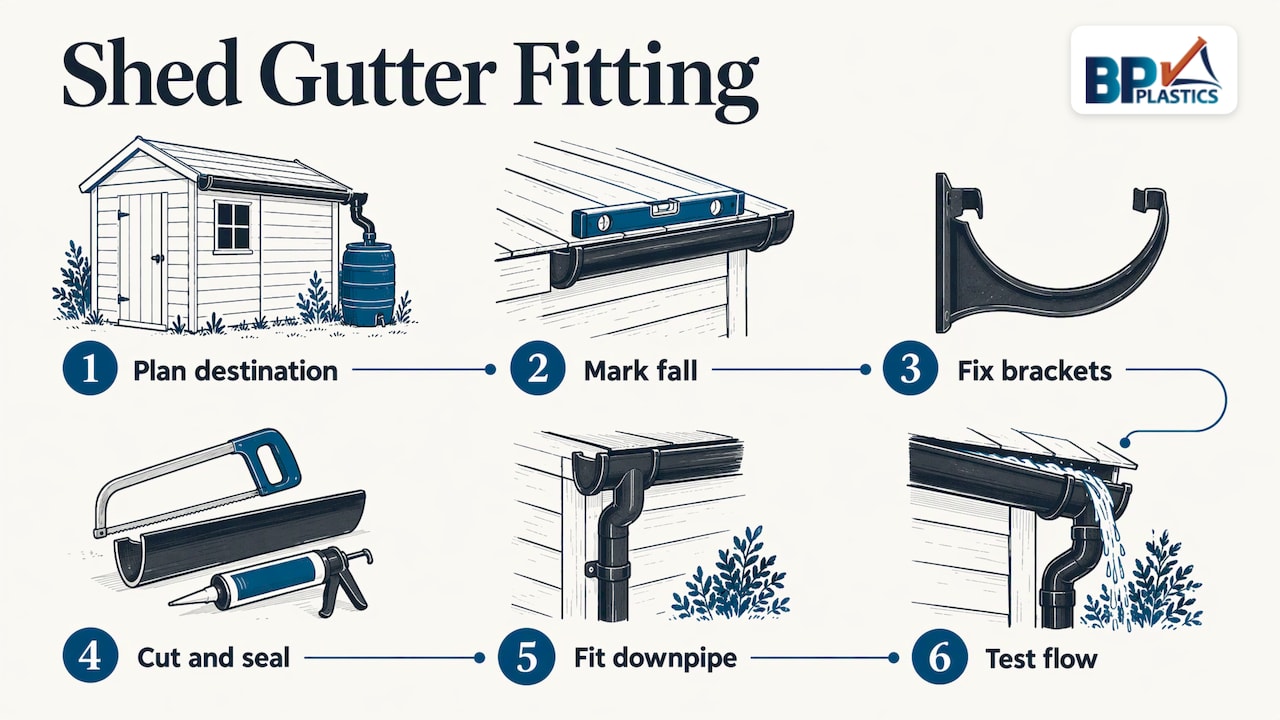
The order below works whether you are doing a one-off or fitting several for a client.
1. Plan where the water will go
Decide the destination before you cut anything. Shedstore advises using nearby drainage if there is any, otherwise channelling the water into a water butt or onto ground that slopes away from the shed. If neither is possible, it suggests extending the downspout about a metre from the shed to stop pooling (Shedstore). The outlet position follows from this decision: put it at the end nearest the butt or the drain.
2. Mark the fall
Gutters must slope gently towards the outlet or the water sits in the channel, grows algae and overflows at the low end. Mark the highest bracket position at the end furthest from the outlet, then mark the lowest at the outlet end. A drop of a few millimetres per metre is enough. On a short shed run, a total drop of a centimetre or two is plenty. Stretch a string line between your marks and mark the bracket positions along it.
3. Fix the brackets
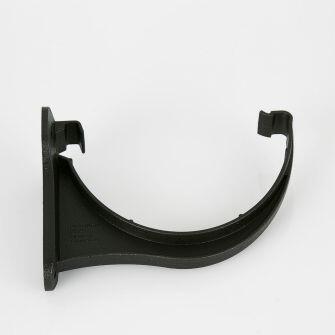
Fix the brackets at regular intervals along the fascia, with one close to each end and one either side of every joint, outlet and angle. Short runs are easy to over-bracket, but it costs little and stops sagging. Pre-drill into timber to avoid splitting thin boards. If you are doing a run of units, buy a few spare clips. Our spare gutter clips are available for the ogee profile, and it is the sort of item that is cheap to add to the order and awkward to be short of on site.
4. Cut, fit and seal
Cut the gutter to length with a fine-toothed saw and remove burrs. Clip it into the brackets, push on the stop end at the high point and fit the outlet at the low point. Make sure the gutter sits fully in the union or joint seal, because a half-seated joint is the number one source of drips. Lubricate rubber seals with a little water or the manufacturer’s recommended lubricant, not oil.
5. Fit the downpipe
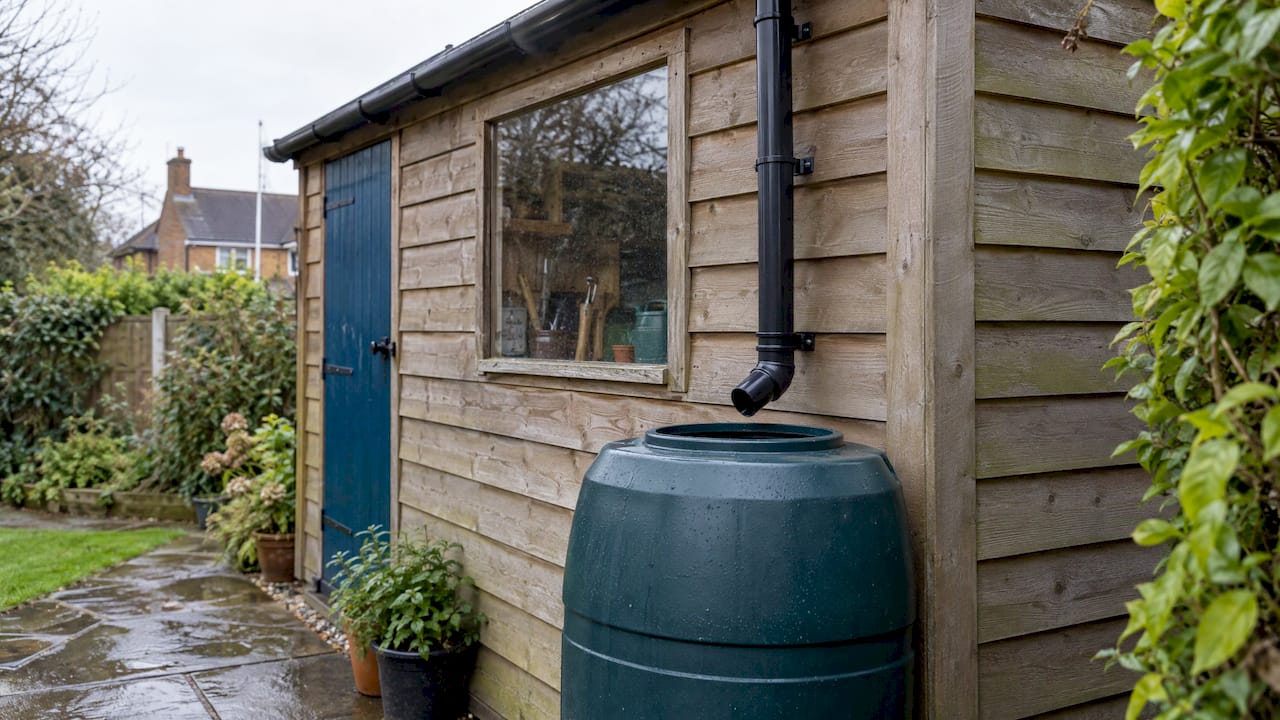
Connect the downpipe to the outlet, keep it plumb and clip it to the shed wall at intervals. If it ends at a water butt, cut it so the end sits just above the butt’s inlet or fits a diverter. If the water goes to a drain, make the final connection with the right adaptor. Where it discharges to ground, add a splash pad or a short gravel bed so it does not scour a hole.
6. Test with a bucket
Pour a few buckets of water into the high end and watch the full length. You are looking for even flow towards the outlet, no standing water and no drips at the joints. Fix any problems before you walk away.
Connecting the gutter to a water butt or a drain
A shed roof is a very good collection surface for a small garden. The Growing Toolkit, a community gardening group, found that even a modest shed or greenhouse roof collected a useful amount of water: it began with two 100-litre water butts and later daisy-chained a third. It also notes that shed roofs normally need proper guttering and connector kits, and that their cost should be budgeted for (The Growing Toolkit).
Some practical points:
- Use a stand. The same source recommends buying a butt with a stand. Raising the butt gives you the height to fill a watering can or to run a hose.
- Put it in the right place first time. A full butt is heavy, and moving it later is hard. Get the base level and solid before filling.
- Use a diverter or an overflow. A diverter fitted into the downpipe sends water into the butt until it is full, then returns it to the downpipe. Without an overflow, a full butt will spill at the lid or the top of the downpipe.
- Daisy-chain when needed. Linking butts lets you add capacity gradually as budget allows, which is how the community garden above built up its storage over several years.
If you are scaling beyond a couple of butts, for example on a landscaping scheme where several outbuildings drain to one store, the sizing logic moves towards attenuation tank sizing, where roof area, rainfall and release rate decide the volume.
If the water goes to a drain instead, check what the drain is. Rainwater should go to a surface water drain or a soakaway, never to a foul sewer. Our range includes soakaway crates and underground drainage pipe and fittings for that part of the job, so a gutter, a downpipe and the run to a soakaway can come from one order.
Maintenance: keeping a shed gutter working
Small gutters block easily because the channel is narrow. Leaves, moss and seeds from the roof felt collect at the outlet.
- Clear the gutter at least twice a year, and after autumn leaf fall in particular.
- Fit a leaf guard or a mesh basket over the outlet if the shed sits under trees.
- Check brackets and joints each spring. Replace any clip that has cracked, because one failed bracket lets the whole run sag.
- Make sure the end of the downpipe has not become blocked with soil or silt.
If the gutter overflows in heavy rain even when it is clean, the cause is usually one of three things: not enough fall, an undersized outlet or a roof area that has outgrown the gutter. All three are easy to diagnose with the measurements you took at the start.
Shopping list for a typical shed
For a standard single run on a pent roof with a water butt at one end:
| Item | Quantity |
|---|---|
| Gutter lengths | Enough to cover the eaves, with a little to cut off |
| Stop end | 1 |
| Running outlet | 1 |
| Brackets | One every 1 m or so, plus one at each end, plus spares |
| Downpipe | Length to reach the butt inlet |
| Downpipe clips | 2 or 3 |
| Diverter kit | 1 if filling a butt |
| Fascia board or batten | Length of the run, if the shed has none |
| Fixings | Screws suited to the timber |
For an apex roof, double the gutter, add a second stop end and plan a connecting run or a second downpipe.
Where Plastic Drainage fits in
If you are fitting more than one outbuilding, a larger garden building or a site job where the gutter is one item among many, it helps to buy it all from one supplier. Plastic Drainage supplies guttering, downpipes and fittings, plastic and uPVC fascia and soffits, land drainage pipe and fittings, and underground drainage supplies, with bulk buy deals for trade customers and an optional trade counter. Our products are sourced directly from UK companies and our range is held in stock for quick delivery, with nationwide dispatch.
For the rainwater side of a garden build, from gutter to soakaway, start with our drainage supplies range.
If you are planning a larger building and want to see how guttering is set out on a long run, our guide to installing industrial guttering covers the same principles at a bigger scale.
FAQ
What size gutter does a garden shed need?
For a small shed roof, a compact half-round gutter with a narrow round downpipe is the usual choice. Measure the roof area, including the overhang, and keep the sum in mind: each millimetre of rain on a square metre is one litre. If the roof is large, or the building is a garage or workshop, use a full-size system.
Do I need a fascia board to fit shed guttering?
Yes, or something equivalent. Shedstore’s guidance prefers a fascia board around the roof edge because it provides a stable fixing, rather than depending on the wall. If your shed has no fascia, fix a timber batten into the roof frame along the eaves before you fit the brackets.
How do I connect shed guttering to a water butt?
Place the butt on a level stand beneath the outlet end. Cut the downpipe to finish just above the inlet, or fit a diverter into the downpipe so water fills the butt and then returns to the pipe when it is full. Make sure the butt has an overflow, and link a second butt later if you want more capacity.
How much fall should a shed gutter have?
A slight fall towards the outlet is enough, a few millimetres per metre. Too little and water stands in the channel; too much looks untidy and strains the brackets. Mark both ends, stretch a string line and bracket along it.
Can I put guttering on a Keter shed?
Usually it needs a timber support or manufacturer-approved fixings, because the moulded roof has no fascia. Read the shed’s instructions before drilling, then follow the same fall, outlet and downpipe rules as for any shed.
Sources
- How to Install Guttering on a Shed, Shedstore
- Collecting and storing rainwater, The Growing Toolkit
- Attenuation Tank Sizing: A UK Method, Inputs and Worked Example