A sewer pipe replacement goes well when three things are settled before anyone digs: who owns the pipe, what the survey says about the failure, and a full parts list for the new run. Get those right and the dig itself is a matter of trench, bed, lay, test and backfill. Get them wrong and you pay for a second excavation. This guide covers the sequence for private drains, and shows how to specify and buy the pipe and fittings in one order. We supply underground drainage pipe, fittings and chambers with bulk deals, so the parts list is where we can take the most work off your hands.
TL;DR
- Check ownership first. Since 1 October 2011 many former private sewers and lateral drains belong to the water company, while a drain serving only your property inside its boundary is yours.
- Survey before you choose a method. A CCTV survey tells you whether you need a patch, a lining, a pipe replaced in the same line or a full open-cut replacement.
- Specify to British Standards, lay on a granular bed and surround, then air or water test before backfilling.
- Count every coupler, junction, adaptor and rodding point up front. Missing fittings are what stop a trench job halfway.
- Work near other services must follow HSE guidance, and work on public sewers needs the water company’s written agreement.
Table of Contents
- Who is responsible for the pipe?
- Signs the pipe needs replacing
- Survey first, then choose the method
- Specify the new pipe correctly
- Plan the fittings before the dig
- How to replace the pipe, step by step
- Common mistakes
- Order the whole job together
- Rules and standards that apply today
- FAQ
- Sources
Who is responsible for the pipe?
This decides who pays and who is allowed to touch the pipe, so settle it first.
Defra’s guidance on the private sewers transfer says that from 1 October 2011, privately owned sewers and lateral drains connecting to a public sewer passed to the water and sewerage company. It also defines the terms:
- A sewer serves more than one property.
- A lateral drain serves a single property but runs outside that property’s boundary (its curtilage).
- A drain inside the boundary that serves only that property stays the owner’s responsibility.
In practice, a failing pipe under your own garden that carries only your waste is yours to replace. A shared run, or the section beyond your boundary, normally sits with the water company. The guidance covers England and Wales, so check the position separately elsewhere in the UK.
If you own a private sewer and want it taken on, a water company can adopt an existing private sewer under Section 102 of the Water Industry Act 1991. That is discretionary and involves the company assessing the actual system, and it is why new sewers are normally built to adoptable standards from the start.
Any work on public sewerage apparatus has to be agreed in writing with the water company. United Utilities’ contractor guide sets that out, and it also requires workers in medium or high risk confined spaces to hold a recognised confined-space award. Treat that step as part of the process, not an obstacle: it is the water company’s call, and your paperwork should be ready before you start.
Signs the pipe needs replacing
A blocked drain alone does not mean a pipe is finished. Replacement is usually justified when the survey shows one of these:
- Collapsed or crushed sections, common in old clay or pitch fibre pipe.
- Displaced or open joints letting in roots or silt.
- Repeated blockages at the same point, often a sign of a sag or a broken pipe.
- A pipe that is too shallow or too small for the new load, for example after an extension.
- Leaks that show up as damp ground, sinking paving or a smell near a chamber.
The surface symptoms look the same for many faults. A CCTV survey is what separates a joint that can be fixed from a run that must come out.
Survey first, then choose the method
Ofwat’s February 2026 technical guide to gravity sewers groups the options into three families:
- Internal remote repairs: root removal with patch repair, cutting away defective connections, removing obstructions, and grout injection to seal leaks.
- External clamp repairs: these need open excavation to reach the pipe.
- Refurbishment by relining: cured-in-place pipe (CIPP) is described as the most common lining technology in the UK.
For full replacement, the same guide lists trenchless routes. Pipe bursting breaks the old pipe while pulling new pipe along the same line. Sliplining inserts a smaller pipe inside the old one. Horizontal directional drilling bores a new path and pulls pipe through. These reduce surface disruption compared with open-cut replacement, which the guide calls highly disruptive and costly in built-up areas.
For a typical garden, drive or new-build plot, open-cut replacement with new rigid or structured-wall plastic pipe is the straightforward route: you can see the bedding, check the gradient and test every joint. Pipe bursting also pulls in new plastic pipe, so the same specification thinking applies.
Costs depend on depth, length, access, ground conditions and how much surface has to be reinstated. Ask for a quote that separates labour, plant, disposal, reinstatement and materials, because materials are the part you can control and compare line by line.
Specify the new pipe correctly
The specification is where cost-effective and correct meet. Use pipe made to a British Standard, with the right strength for the depth and load.
Thames Water’s sewer construction guide says pipe for adoptable sewers must meet the water industry’s adoption code. That includes clayware, concrete, ductile iron and plastic, and each product must meet the relevant British Standard and a minimum loading strength. Plastic is the usual choice for domestic and light commercial runs because it comes in manageable 3m lengths and is jointed by pushing into a rubber-ringed socket.
For buried pipe, the Water UK design guidance says to design to BS EN 1295-1 and BS 9295. Where cover over the pipe is less than the recommended minimum, protection must be a concrete slab, a concrete surround with flexible joints, or ductile iron pipe. Shallow runs under drives and parking areas are where this matters most.
A practical checklist before ordering:
- Diameter: match or exceed the old pipe and the connection point. Domestic runs are commonly 110mm; larger or shared runs use bigger sizes.
- Pipe type: solid-wall underground drainage pipe for standard runs, twin wall for larger diameters and civil work.
- Depth and loading: confirm the cover depth and whether vehicles will cross the line.
- Joints and transitions: you will meet old clay, pitch fibre or cast iron at the tie-in, so plan adaptors for each.
- Access: rodding eyes, inspection chambers or manholes at changes of direction and junctions so the line can be cleared later.
Our guides on underground drainage pipe and UPVC underground drainage pipe cover sizes, pipe types and how the sockets work. For the regulations side, see our guide to plastic drainage systems and building regulations.
Plan the fittings before the dig
Pipe is the easy part of the order. The jobs that stall are the ones where the trench is open and you are one coupler short.
Walk the route on paper and list every:
- Straight repair or slip coupler where you join to existing pipe or cut out a damaged section. A 110mm double socket slip coupler lets you slide over to close a gap without disturbing the neighbouring pipe, and it comes as a bulk pack of 48.
- Junction where a branch joins the run. A 110mm equal tee junction is sold in a pack of 10.
- Transition to old pipe: a flexible adaptor with band seal joins plastic to plastic where the sockets or outside diameters differ, and is available in a pack of 50. For ribbed pipe, there is a 150mm Ultrarib/Polysewer socket adaptor for EN1401 PVC pipe spigot.
- Access point: a 45 degree rodding eye with socket tail or spigot tail gives rodding access at the head of a run or at a bend, without a chamber.
The Water UK guidance recommends building in junctions for every planned connection when a sewer is laid, to avoid damaging it by adding connections later. If a new kitchen, utility room or outbuilding is likely, put the tee in now.
For a standard 110mm job, the 35-piece underground drainage starter kit gives you a base set of fittings in one order. Add pipe lengths and any special transitions on top.
How to replace the pipe, step by step
The sequence below follows the contractor guidance published by water companies, which is written for adoptable sewers and is a sound benchmark for private work too.
1. Plan the excavation and check for services
HSE’s HSG47 guidance on underground services calls for a written excavation plan before work near buried services, competent workers with PPE, careful exposure and marking of identified services, and a permit system for particularly hazardous work. It says concrete must not be used to encase services when backfilling, and that damage to a service must be reported to its owner. Get plans of gas, water, electric and telecoms before you break ground, and hand-dig near them.
2. Dig and support the trench
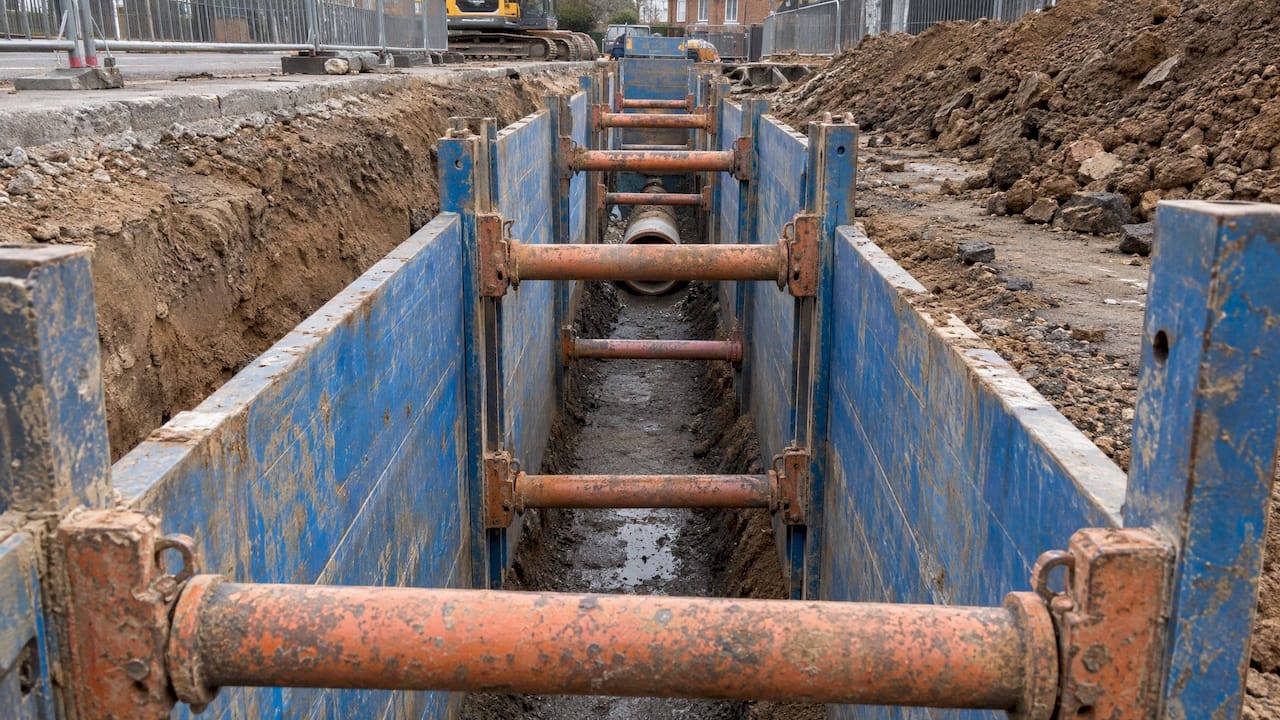
The Thames Water guide requires trench walls to be supported with boxes or struts to HSE guidelines, with spoil kept safely away from the open excavation. United Utilities adds that trenches should be supported, dewatered to a firm base and not dug wider than necessary. A trench deeper than about a metre and a half can collapse without warning, so never work in an unsupported one.
3. Bed the pipe and set the gradient
Lay the pipe on a granular bed. Use a pipe laser or boning rods to hold a consistent fall. A sag collects solids and becomes the next blockage, so check levels at every length rather than at the end.
4. Lay and joint
United Utilities specifies pipes laid in lengths of no more than 3m, with joints pushed fully home into clean sockets. Wipe out each socket and ring, lubricate the spigot, mark the insertion depth and push to the mark. Dirt in a ring seat is the most common cause of a leaking joint.
5. Make the connection
When tying into a public sewer, the Thames Water guide does not permit T junctions or clay saddles. It allows only new manholes, pre-formed oblique junctions or flexible plastic saddles, with the saddle diameter no more than one third of the main sewer diameter. This connection is part of the water company’s approval process, so agree it with them first.
6. Test before you backfill
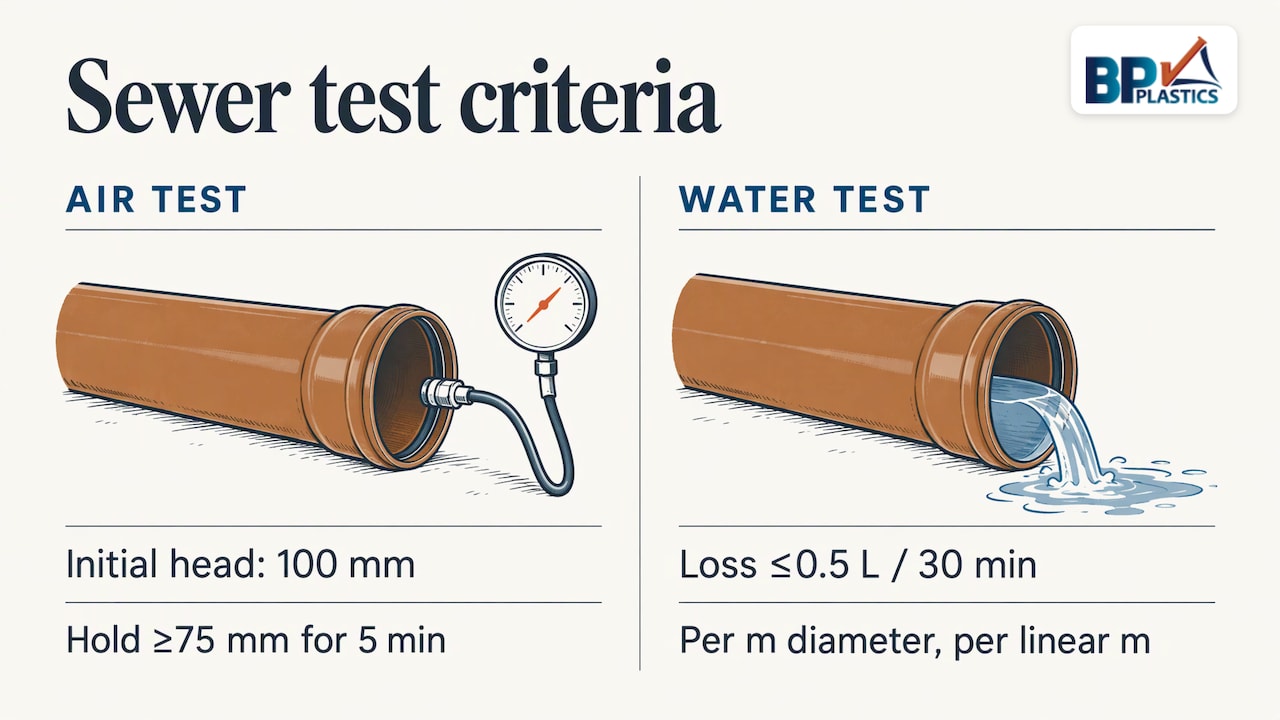
United Utilities’ guide sets out the air test as holding a 100mm head to at least 75mm for 5 minutes, or a water test where loss must not exceed 0.5 litres per 30 minutes per metre of diameter per linear metre. Thames Water states that all sewers up to 750mm must be tested and pass an air or water test. Test with the joints still exposed so any weeping joint can be fixed while the trench is open.
7. Survey, surround and backfill
For adoptable sewers a qualified contractor must CCTV-survey the cleaned line, and thermoplastic pipe with more than 6% deformation must be replaced. Even on a private job, a post-lay camera run is useful evidence of a good installation. Backfill with granular bedding and surround to 300mm above the pipe crown, then compact the backfill in 150mm layers. Do not drop stone or rubble directly onto the pipe.
Common mistakes
- Mixing pipe systems without the right adaptor. Imperial and metric outside diameters, ribbed and smooth pipe and old clay all need the correct transition.
- Too little cover. Shallow pipe under traffic needs protection, as above.
- No access points. A run with no rodding eye or chamber at bends cannot be cleared cleanly.
- Backfilling before the test. It saves an hour and can cost a day.
- Under-ordering fittings. Couplers and junctions are cheap per piece, and the delay while you wait for one is not.
Order the whole job together
A replacement run needs pipe, couplers, junctions, adaptors, access points and often chambers or geotextile wrap, and ordering these separately from several places is how jobs run late. We stock a full range of underground drainage supplies, including pipe, fittings, inspection chambers and geotextiles, with bulk deals on the fittings that a run uses in quantity. Our positioning is simple: low prices on bulk purchases, a wide range in stock for quick delivery, and certified products sourced directly from UK companies, dispatched nationwide.
For a straightforward domestic run, start with the 110mm starter kit, then add lengths and transitions from your parts list. For larger or civil work, the 250mm single socket pipe in 3m lengths is on our site, and the full range is on plasticdrainage.co.uk.
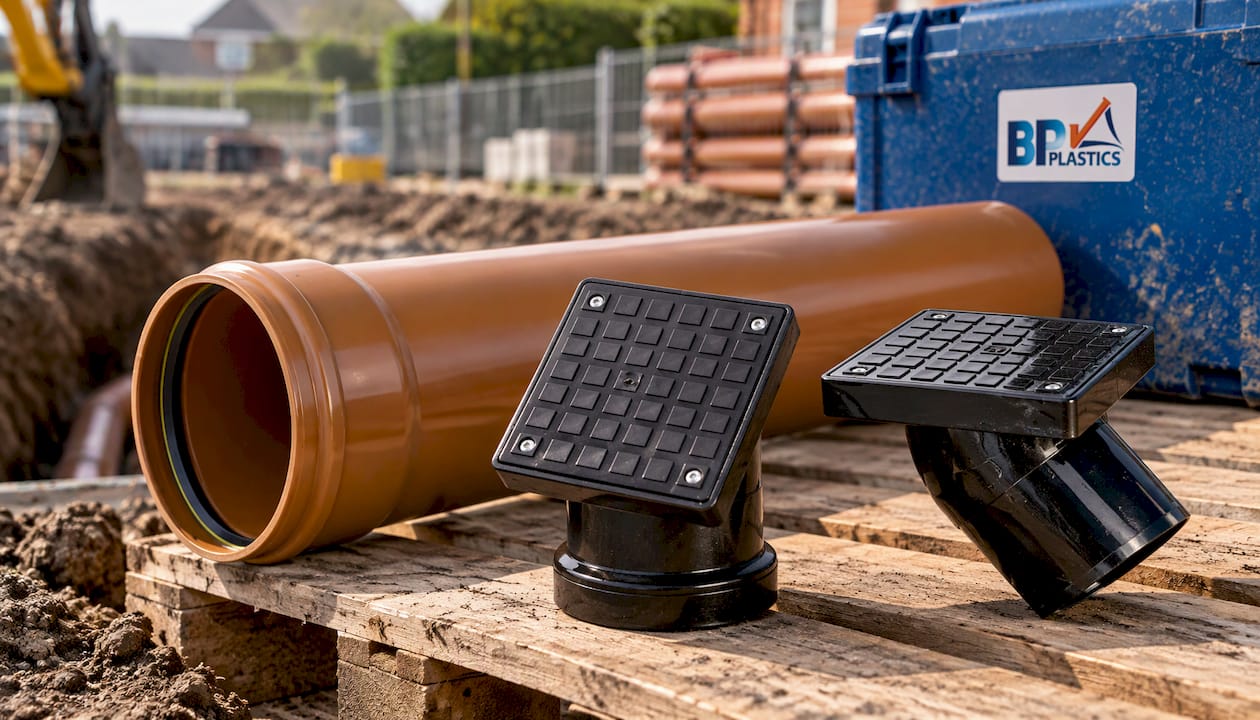
If you are building a list for several jobs, order the repeat fittings in the bulk packs and keep a few spare couplers and adaptors on the van. Contractors, groundworkers and landscapers can order online, and a trade counter service is also available.
Rules and standards that apply today
A few points are worth knowing before you quote or start.
- HSE guidance on underground services (HSG47, 2014) is the benchmark for excavation near buried services and has not been replaced.
- Water company approval is needed for work on public sewers. Under the Environment Act 2021 commencement regulations, drainage and sewerage management plans came into force on 1 September 2024 for undertakers in England, and near real-time reporting of storm overflow discharges followed on 1 January 2025. These duties fall on the water companies, not on a householder replacing a private drain, but they explain why companies are tightening how connections to the public network are made and recorded.
- Building Regulations Part H governs drainage for new work and alterations. Our regulations guide summarises what it asks of the pipework.
If your job involves a shared sewer, a connection to a public sewer or a drain close to a building’s foundations, speak to the water company, your building control body or a structural engineer before digging.
FAQ
Can I replace a sewer pipe myself?
You can replace a private drain within your own boundary if you plan the route, check for services, support the trench and test the joints. Any work on a public sewer, or a connection into one, needs the water company’s written agreement, and confined-space entry requires trained and certified workers.
How long does a sewer pipe replacement take?
It depends on length, depth, access, ground conditions and reinstatement. A short private run in open ground can be a matter of days, while a connection to a public sewer involves a site visit, survey and approvals before the dig. Ask for the programme in writing before work starts.
What pipe should I use for underground sewer replacement?
Use underground drainage pipe made to the relevant British Standard, in a diameter that matches or exceeds the old pipe, with the right strength for the cover depth and loading. Domestic runs are commonly 110mm, and larger sizes suit shared or civil work. Our underground drainage pipe guide explains the options.
Do I need to test the new pipe?
Yes. Water company guidance requires an air or water test on sewers before backfilling, and a CCTV survey of the finished run is good practice on any job. Testing with the trench open lets you correct a leaking joint straight away.
Who is responsible for a drain that serves several houses?
Since 1 October 2011 a shared pipe that was previously private, and a lateral drain beyond your boundary, normally belong to the water and sewerage company in England and Wales. Check with your water company if you are unsure.
Sources
- Defra: The private sewers transfer regulations guidance
- Planning Geek: Section 104 and 102 agreements
- United Utilities: Site sewer construction guide
- Ofwat: Gravity Sewers technical guide
- Thames Water: Your new sewer construction guide
- Water UK: Sewerage Sector Guidance Appendix C
- HSE: Avoiding danger from underground services HSG47
- legislation.gov.uk: Environment Act 2021 (Commencement No. 9 and Transitional Provisions) Regulations 2024