For a French drain, use a perforated plastic land drainage pipe, laid with a steady fall in a trench of clean stone and wrapped in geotextile fabric. The fabric keeps silt out of the stone. The pipe does the work, so its size, strength and fittings decide whether the drain still runs in ten years. We supply the perforated land drain coil, the fittings and the geotextiles for the job. This guide covers what to buy and how to lay it.
TL;DR
- A French drain is a perforated pipe in a stone-filled trench, usually lined with geotextile fabric, that carries water to an outfall such as a soakaway, ditch or drain.
- Pipes for French drains are typically 100 to 150 mm in diameter, laid at a fall of about 1:80. Use pipe made for land drainage, not a pipe not designed for the job.
- Line the trench with fabric to keep soil out of the stone. Wrapping the pipe itself suits fine, sandy soils.
- Plan for access: rodding points and a clear outlet matter more than any other detail if you want the drain to last.
- Keep the drain well away from building walls, and talk to your building control body before work that discharges from a building.
Table of Contents
- What a French drain does, and why the pipe matters
- Which pipe to use for a French drain
- French drain pipe sizes
- Fabric for a French drain
- What stone to use
- How to install a French drain
- Where French drains go wrong
- Building Regulations and design
- Keeping a French drain working
- Buying the pipe, fabric and fittings together
- FAQ
- Sources
What a French drain does, and why the pipe matters
A French drain collects water from saturated ground and carries it away. The SPAB, the UK’s building conservation society, describes it as a perforated pipe laid in a shingle-filled trench, with the water conveyed to a soakaway, a watercourse or a mains drainage system.
Water moves through the stone far more easily than through the surrounding soil. It enters the pipe through the perforations and runs along the fall to the outlet. Three parts have to work together:
- The stone gives water a fast route to the pipe.
- The fabric stops soil washing into the stone and filling the gaps.
- The pipe carries the flow once it is collected.
A pipe that is crushed, undersized or laid to the wrong fall cannot be fixed from the surface. It is the one part you will want to get right first time.
Which pipe to use for a French drain
Use a perforated plastic land drainage pipe. It is light, cut with a saw, and designed to sit in wet ground. The National Field Drainage Guide from the NFLG notes that new field drainage schemes in the UK are installed with plastic pipes, and that material designed for field drainage must be used.
The choice is between two main types.
Flexible coiled land drain
This is the standard choice for gardens, paddocks, sports surrounds and long runs. It comes in coils, so a 50 m length can be laid with no joints. Fewer joints mean fewer places for stone or silt to get in. It is easy to carry to the trench and easy to lay on a straight line.
Our 160mm x 50m perforated land drain coil suits the larger runs. Join lengths with a 160mm land drainage coupler, and where several runs meet, use a 160mm multi junction to bring them into one outlet.
Twin wall pipe
Twin wall pipe has a corrugated outside and a smooth inside. The smooth bore helps flow, and the profile gives the ring stiffness to carry load. The NFLG guide says twin-wall pipe (or a gravel surround) should be considered where there is a risk of the pipe being crushed. That means ground that will be driven over, or deep trenches. We stock twin wall drainage pipe and fittings alongside land drainage.
Plain pipe, perforated pipe and sleeved pipe
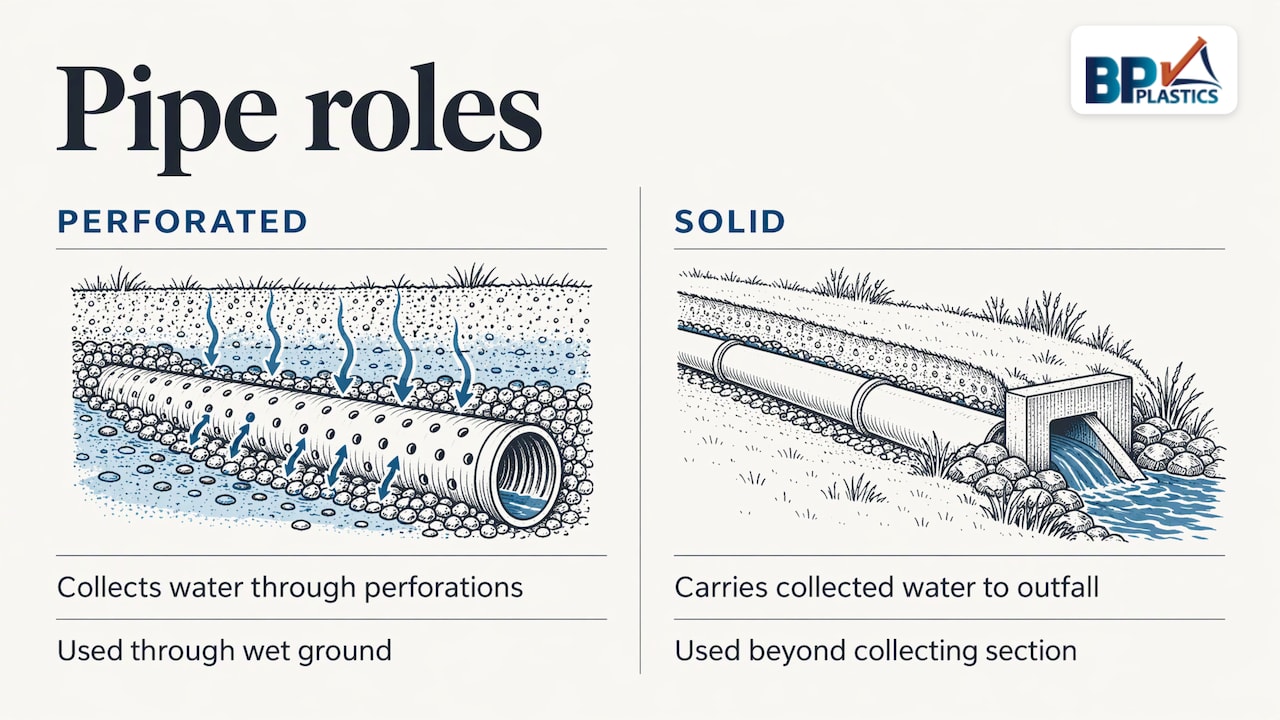
A French drain needs perforated pipe, because the perforations are how water gets in. Do not use plain solid pipe in the collecting section. Solid pipe has its place downstream: once the water is collected, it can be piped to the outfall in solid pipe. That is why many layouts use perforated pipe through the wet ground and solid underground drainage pipe beyond it. Our guide to underground drainage pipe covers that solid section.
French drain pipe sizes
The SPAB says French drain pipes are typically 100 to 150 mm in diameter. The wider the pipe, the more water it carries at a given fall, and the less likely a small amount of silt is to restrict it.
| Situation | Sensible starting point |
|---|---|
| Single wet patch in a lawn | Smaller bore, within the 100 to 150 mm range |
| Long run along a boundary or paddock | 150 mm or 160 mm coil, fewer joints |
| Heavy or concentrated flow | Larger bore, a wider trench, or more than one pipe |
| Ground that will carry vehicles | Twin wall pipe or a stone surround |
Restoration UK says that where there is a lot of water to deal with, a French drain may need to be widened or use multiple pipes, which also gives some redundancy. If you are sizing for a site with a known flow problem, a civil engineer or drainage designer should give you the flow figure. Choose the pipe from that figure, not from a rule of thumb.
Be consistent. A 160 mm coil needs 160 mm couplers and junctions, and mixing sizes leads to loose joints that let silt in. Buy the pipe and fittings together and check the sizes against each other before you dig.
Fabric for a French drain
Fabric is the part most people get wrong, because there are two places it can go.
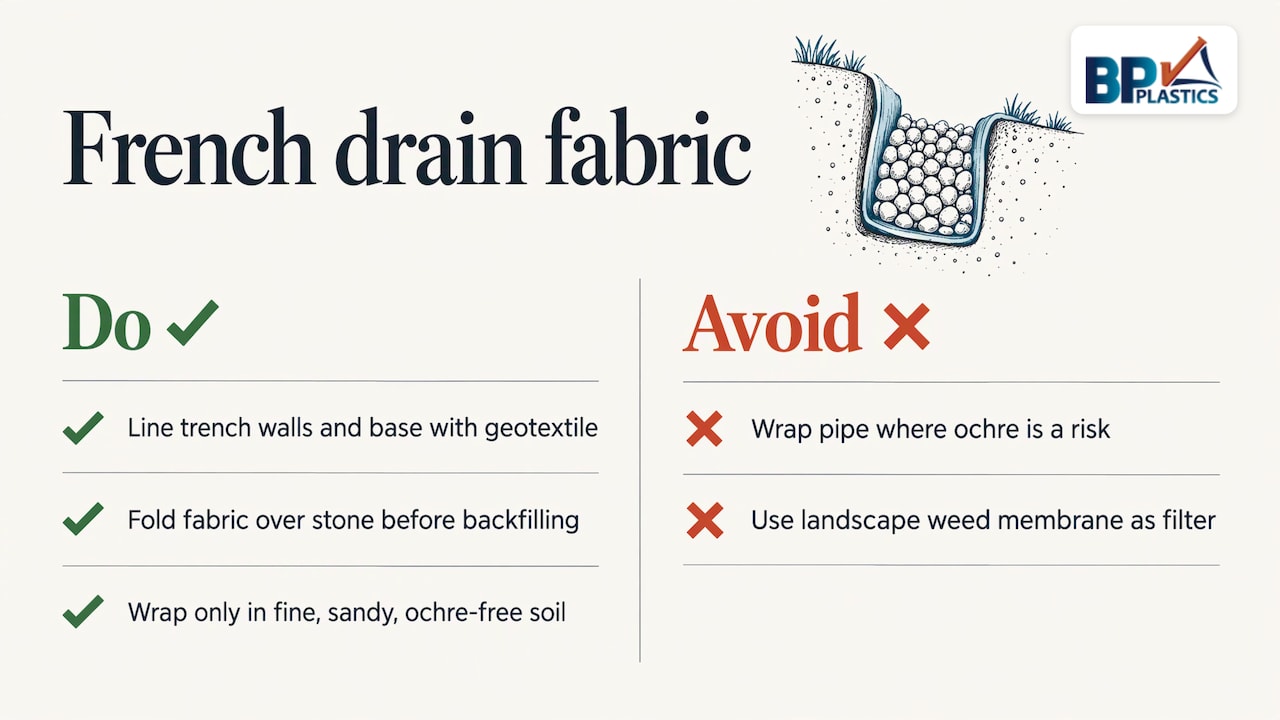
Lining the trench. This is the standard method. Geotextile goes against the trench walls and base, the stone goes on top, and the fabric is folded over the top before backfilling. The SPAB explains that modern methods use a geotextile filter membrane to line the trench, which excludes sediment and allows a coarser stone fill of 20 to 50 mm. Without it, soil particles migrate into the stone and the voids fill. Nordic Damp Proofing lists silt-filled trenches, caused by a lack of membrane, among the common French drain failures.
Wrapping the pipe. Here the pipe itself has a filter sleeve. The NFLG guide notes this is not commonly used in the UK, because research found pipe sedimentation is not usually a problem when pipes are laid and maintained properly. It says wrap can help in fine, sandy soils, and should never be used where there is a risk of ochre. Ochre is the orange iron deposit that clogs pipes in some ground.
So the rule is simple. Line the trench in almost every case, and add a pipe wrap only if the soil is fine and sandy and ochre is not an issue. Our range includes geotextiles for this lining, available alongside the pipe in the same order.
Use a non-woven geotextile made for drainage, wide enough to line the trench and fold over the top with a generous overlap. Cheap landscape weed membrane is not a filter fabric and is a false saving.
What stone to use
The stone is the second half of the filter. The NFLG guide says permeable backfill should be hard and durable, wet and dry, mostly 5 to 50 mm in size, with no more than 10% fines. Fines are the dust and small particles that wash down and block the voids. The SPAB gives 20 to 50 mm as the fill that a fabric-lined trench allows.
Two practical points:
- Buy washed, clean stone. Quarry dust in a delivery is fines you have paid for.
- Avoid soft stone that breaks down when wet.
Restoration UK suggests varying the gravel size from coarse at the centre to finer at the outside to minimise clogging. That is a useful refinement where soil is silty and the budget allows a graded fill.
How to install a French drain
The sequence below gives the standard method, with the point where each step usually goes wrong.
1. Settle the outfall first
Work out where the water goes before you dig. The SPAB lists the options: a soakaway, a watercourse or a mains drainage system. A drain with nowhere to discharge simply fills up. Nordic Damp Proofing lists a blocked or missing outlet among the common French drain failures.
If the outfall is a soakaway, a lot depends on how much water arrives and how fast the ground takes it. Our guide to drainage crates and soakaways explains how to size and install them. We supply soakaway crates in the same range.
2. Set out the line and check where it sits
Mark the route with pegs and string. Keep clear of walls. The SPAB says a French drain near an old building must not encroach within a 45° downward angle from the bottom of the foundations, and should ideally sit about a metre from walls. Restoration UK also advises at least a metre from old buildings with shallow foundations.
Check for services before you dig, and decide where the inspection and rodding points will go while the plan is on paper.
3. Dig to a consistent fall
The SPAB gives a fall of approximately 1:80, in a trench 150 to 200 mm wide by 200 to 300 mm deep for a small drain. In practice the trench must be wide and deep enough for the pipe plus a stone surround, so check against the pipe you have chosen and the depth the outfall needs.
1:80 means 125 mm of drop over 10 m. Use a laser or a string line and a level, and check it as you go. Nordic Damp Proofing puts an incorrect fall at the top of its list of common failures. A drain that falls the wrong way, or has a dip, holds water and silts up.
4. Line the trench with fabric
Lay the geotextile across the trench so it covers the base and both sides, with enough spare at each side to fold over the top. Do not stretch it tight. It needs to settle into the trench with the stone.
5. Lay a stone bed and the pipe
Put a bed of clean stone on the fabric, then lay the pipe on it. Run the coil out straight, joining lengths with couplers, and bring runs together with a junction. Check the fall again once the pipe is down, because it can shift.
If you are connecting to solid pipe at the outfall, use the right adaptors for the sizes involved. For 150 mm drainage connections, we list a socket adaptor for 150mm pipe.
6. Add rodding access
The SPAB says good installations include frequent rodding points to make it easier to clear blockages. Wilsham Consulting recommends rodding points, silt traps and concrete chambers as a way to jet the pipe without a full excavation and rebuild. Nordic Damp Proofing lists no maintenance access as a common failure.
This is the step most often skipped, and it is the one that turns a blocked drain from a dig-up into a half-hour job. Plan an access point at changes of direction and at intervals along long runs. Our range includes inspection chambers for this.
7. Fill, compact and fold the fabric over
Fill with stone around and over the pipe. The SPAB and Restoration UK both say to compact each 150 mm layer of aggregate as you backfill, to reduce settlement. Fold the spare fabric over the top of the stone so soil from above cannot wash in, then finish with topsoil, turf or a surface layer, as the site requires.
Where French drains go wrong
Most failures trace back to a short list. Nordic Damp Proofing names them: incorrect fall, a blocked or missing outlet, silt-filled trenches from a lack of membrane, no maintenance access, gravel bridging the damp-proof course, and trenches cut close against older walls.
Two of those are about the building:
- Gravel must not bridge the damp-proof course. Keep the stone below it, so water cannot cross it. This also matters if you finish the surface with gravel.
- Keep your distance from old walls. See step 2.
Nordic Damp Proofing also points out that a French drain does not replace a damp-proof course, and that a trench outside will not fix problems that come from other causes, such as condensation or plumbing leaks. If damp is the reason for the drain, have the cause identified before you dig. Wilsham Consulting adds that a French drain changes the way water flows through the ground. Next to a building, that is a reason to get a professional design.
Building Regulations and design
Wilsham Consulting states that in the UK, French drains next to buildings are typically installed as drainage works under Building Regulations Part H, and are often covered by a planning condition requiring evidence of a professional design with tests and calculations. If your drain takes water from a roof or a building, or the site has a planning condition, speak to your local authority’s building control and to a civil engineer or drainage designer. For a garden lawn away from the house, this rarely applies, but check.
Our guide to plastic drainage systems and Building Regulations sets out how the pipe side of the rules works.
Keeping a French drain working
Silt is the slow enemy. Wilsham Consulting explains that it fills the voids in the stone over time and reduces performance until the drain fails. A blocked drain can also undermine its purpose: the SPAB warns that a blocked French drain can form a moat around a building and make damp worse.
The SPAB advises annual inspection for signs of obstruction. Rawlins Paints’ UK guide gives a routine you can adopt:
- Check the flow after heavy rainfall.
- Remove surface debris every six months.
- Inspect pipe ends and rodding access.
- Use a drain jet or flush system annually.
- Replace or clean the membrane if it is clogged.
That routine only works if the access points were built in. This is the reason to plan them at the start.
Buying the pipe, fabric and fittings together
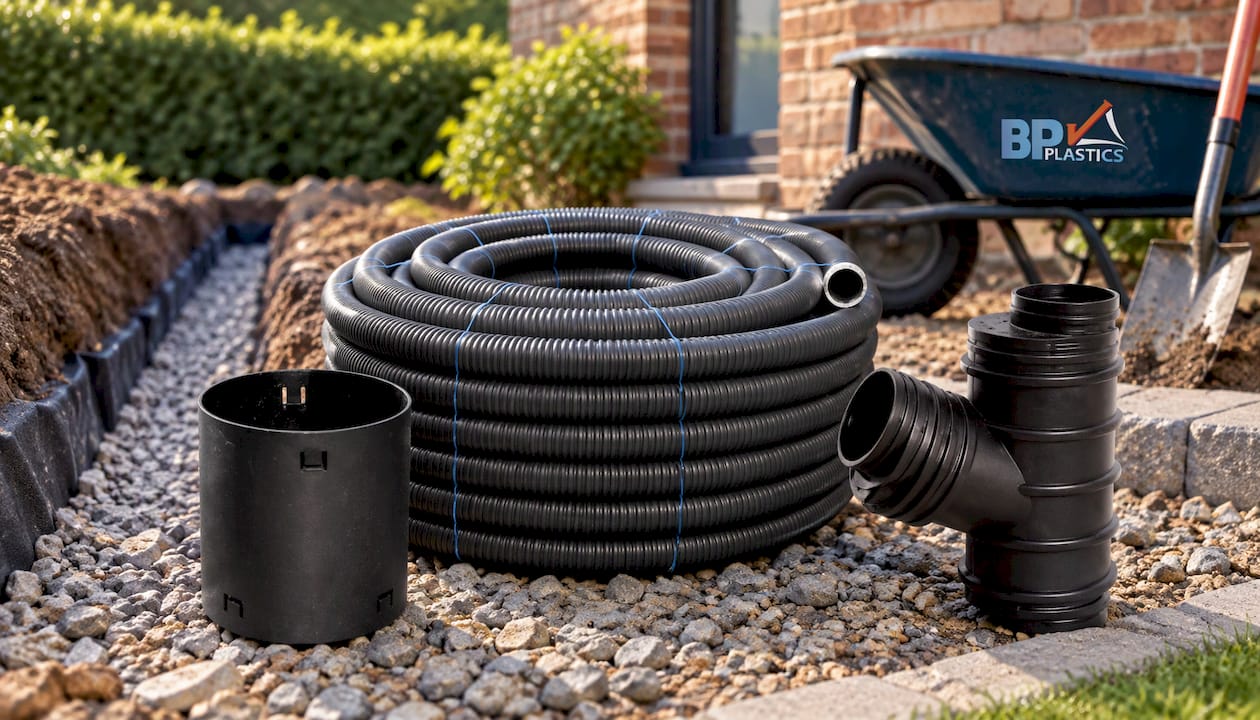
A French drain is a small kit of parts: the coil, couplers, junctions, geotextile, soakaway or outfall components, and the inspection chambers. We hold land drainage pipe and fittings, geotextiles, inspection chambers, twin wall pipe and soakaway crates, with bulk-buy deals for larger jobs. Ordering them in one go keeps the sizes matched, and our nationwide dispatch means the groundworks team is not waiting on one missing coupler.
Start with the perforated land drain coil and the matching couplers. The rest of the range is on our main site.
For contractors working on several drains, the bulk prices help the most on long runs, where coil, fabric and stone quantities add up.
FAQ
What pipe do I use for a French drain?
Use a perforated plastic land drainage pipe designed for the purpose. The SPAB gives 100 to 150 mm as the typical diameter. Coiled pipe suits long runs with few joints, and twin wall pipe suits ground that will carry load.
Do I need fabric in a French drain?
In most cases, yes. Lining the trench with geotextile stops soil mixing with the stone and filling the voids. A wrap directly around the pipe is a separate matter: the NFLG says it can help in fine, sandy soils but should never be used where ochre is a risk.
What fall does a French drain need?
The SPAB gives a fall of approximately 1:80, which is 125 mm of drop over 10 m. Check it with a level or laser as you dig and again once the pipe is laid, because a dip holds water and collects silt.
How far from the house should a French drain be?
The SPAB says ideally about a metre from the walls of an old building, and never inside a 45° line down from the bottom of the foundations. For work next to a building, ask building control and a civil engineer about the design.
How often should a French drain be checked?
The SPAB advises an annual inspection for obstruction. It is also worth checking the flow after heavy rain and clearing surface debris every six months, and rodding or jetting through the access points once a year.
Sources
- French drains, The SPAB
- Field drainage guide, NFLG (2018)
- French drain: professional design, Wilsham Consulting
- Do French Drains Stop Damp? Nordic Damp Proofing
- French drains explained, Restoration UK
- How to Install a French Drain in the UK, Rawlins Paints